Clock Smart, Party Hard: The Insider's Guide to Picking Start Times That Actually Keep the Energy Alive All Night
You spent three days sourcing the perfect charcuterie board, two hours arranging the lighting, and approximately forty-five minutes stress-testing the playlist. And then you put "9 PM" on the invite, watched your first guests roll in at 10:15, and wondered why the whole night felt like it never quite caught fire.
Here's the uncomfortable truth: party timing is a science, and most hosts are winging it. The start time on your invite isn't just a logistical detail — it's the opening move in a strategic game that determines whether your party builds beautifully or limps to the finish line. Let's fix that.
Why "Fashionably Late" Is Actually Built Into Human Psychology
Guests arriving late isn't rudeness — it's instinct. Nobody wants to be the first person standing in a half-lit living room making awkward small talk with the host while they're still arranging napkins. Social gatherings have an unspoken "warm-up" period, and your guests know it even if they can't articulate it.
Research in social dynamics consistently shows that parties reach their energy peak when roughly 60 to 70 percent of expected guests have arrived. Before that threshold, the room feels sparse and the energy is tentative. After it, the room has critical mass — conversations overlap, laughter compounds, and the whole thing starts running itself.
The problem with a 9 PM start is that you're already fighting your guests' evening rhythms. People have eaten dinner, possibly had a drink or two at home, and are now deciding whether to change out of their couch clothes. Your party is competing with Netflix. A 9 PM invite often means a real start closer to 10 PM — and if the party was always meant to wind down by 1 AM, you've just cut your peak window in half.
The Right Start Time for Every Type of Party
Not all parties are built the same, and your start time should reflect the specific arc you're trying to create.
The Cocktail Party (Duration: 2–3 hours) This is a contained, civilized affair. You want guests arriving in a tight window so the energy is consistent from the jump. A 6:30 or 7 PM start is the sweet spot — early enough that people come straight from work or dinner prep, late enough to feel like an event. Put a soft end time on the invite ("6:30–9:30 PM") so guests know this is a sprint, not a marathon. That urgency actually helps the energy.
The Dinner Party (Duration: 3–4 hours) For a sit-down dinner, precision matters. You're working around food timing, which means you need guests there before the kitchen hits its final countdown. A 7 PM arrival with dinner at 7:45 gives people enough cocktail-hour buffer to settle in without you holding a soufflé hostage at 8:30. Send a gentle note in the invite: "Dinner at 7:45 — we'd love everyone seated by then."
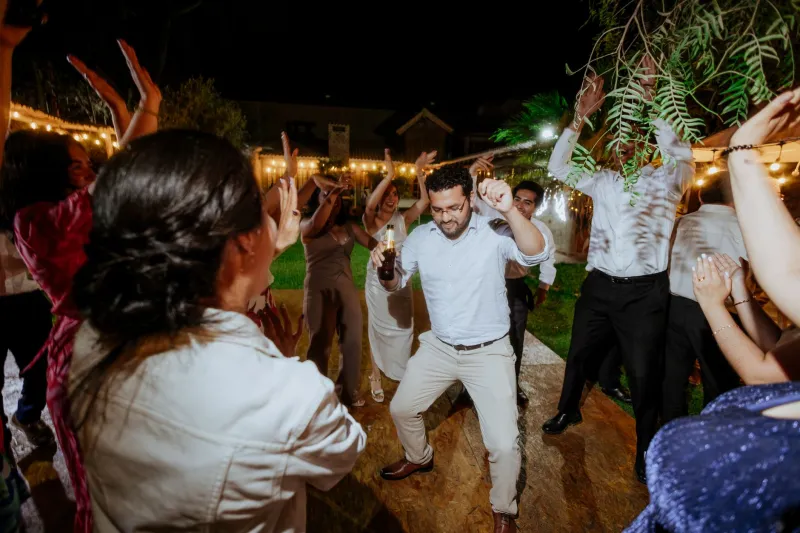
The Full-Send House Party (Duration: 5+ hours) This is where staggered arrivals are your best friend. Tell your closest, most socially confident friends to arrive at 9 PM sharp — these are your "room warmers," the people who will have the energy already going when the second wave hits at 10. By 10:30, the room should be at critical mass and running on its own momentum. Don't invite everyone for 9 PM unless you want forty people standing in your kitchen eating chips in silence.
The Brunch or Day Party (Duration: 3–4 hours) Go earlier than feels comfortable. An 11 AM start sounds aggressive until you realize that a noon start means the party is still warming up at 1 PM, which means it's peaking at 2 PM, which means it bleeds into everyone's Sunday evening plans. Eleven o'clock arrivals, brunch served at 11:30, and you'll have a room that's genuinely cooking by noon.
The Buffer Window: Your Secret Weapon
Here's a tactic professional event producers use that almost no home host considers: the intentional buffer window. Instead of listing a single start time, give guests a 30-minute arrival range.
"Join us anytime between 7 and 7:30 PM" does several things simultaneously. It signals that this is a real event with a defined shape (not a vague "come whenever" situation that produces chaos). It distributes arrivals so you're not greeting fifteen people at once. And it subtly communicates that showing up at 9 PM for a 7 PM invite is not, in fact, charming.
For larger parties, consider a two-wave invite strategy. Send your inner circle the real start time. Send everyone else the time that's thirty to forty-five minutes later. By the time the second wave arrives, there's already a party to walk into — and that first impression of a buzzing room does more for your event's energy than any decoration ever could.
Reading the Room Before Anyone Arrives
The final piece of the timing puzzle isn't about when guests show up — it's about how long you plan to sustain the energy. Every party has a natural arc: warmup, peak, plateau, and wind-down. The mistake most hosts make is not planning for the plateau.
After your party hits its peak, energy will naturally taper. That's not failure — that's physics. The question is whether you have a plan to either re-energize the room (a game, a toast, a playlist shift) or gracefully guide the wind-down. A party that ends on a high note — guests laughing on their way out the door — is remembered as legendary. A party that trails off into awkward stragglers at 2 AM is remembered as exhausting.
Plan your peak. Engineer your start. Own your timing. The best party you've ever thrown isn't a matter of luck — it's a matter of knowing exactly when to pull which lever.
Now go update that invite.